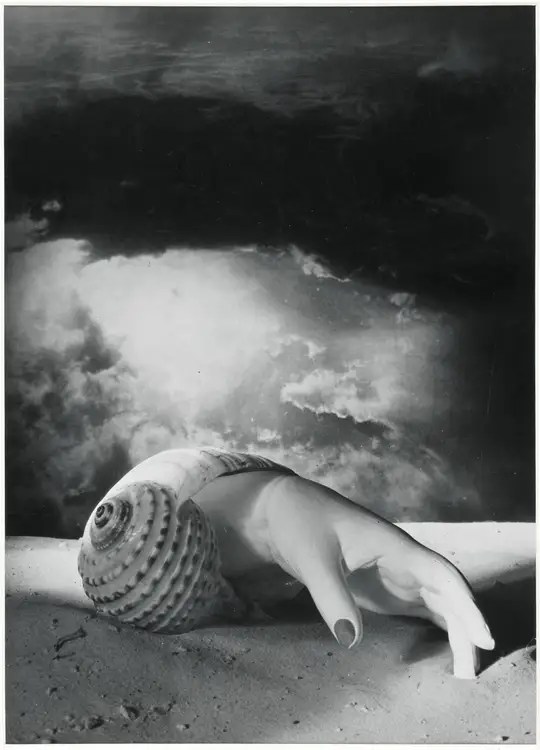
Dora Maar – Untitled (Hand-shell) 1934
Dora Maar was a professional fashion photographer in 1930s Paris, an engaged intellectual, Picasso’s artistic confidante and a painter in her own right – one of few women in the Surrealist group. Her first solo retrospective came in 2019 where she could finally be seen as her own artistic person, not as an adjunct to Picasso or other Surrealists. That’s a long journey from being the subject of Picasso’s Weeping Woman of 1937… a fitting tribute to Maar’s fighting spirit and independent vision.
Shell-hand is a strikingly dreamlike and enigmatic photomontage created by Dora Maar in 1934 using a large format camera in her Paris fashion photo studio. In the carefully composed foreground, the left hand of a female mannequin emerges seamlessly from a conch shell, to rest in the sand, her middle finger sinking into it with suggestive langour. The distant backdrop is created by another image of an ominous stormy sky which hovers between sea and cloud in a disturbing, mystical light. The skilful use of foreground studio lighting perfectly complements the distant light source.
The photo-montage is an artwork of stark contrasts – natural elements on the verse of unleashing fury are juxtaposed with the sensuality of a disembodied, manicured hand, suggesting independence and a decadent defiance of danger. The conch shell itself could refer to the Birth of Venus (eg Botticelli) and the wiles of feminine seduction seen at their most vulnerable (birth).
This brings me to the point of the blog – the interesting question of how can the often banal medium of photography manage to pull off a genuinely surreal image? What is the connection between realism and surrealism? In 1924, Andre Breton wrote the Surrealist Manifesto, in which he called for “Pure psychic automatism, by which one proposes to express, either verbally, in writing, or by any other manner, the real functioning of thought…in the absence of all control, exercised by reason, outside of all aesthetic and moral preoccupation.”
Dora Maar’s chosen surreal medium was photo-montage, derived from Max Ernst’s collages – distinguished by their skilful illusion of reality, while drawing on iconography central to surrealist preoccupations, in this work: eroticism, sleep, the eye, the unconscious, the maritime realm. Unlike the free form fantasies of Dali or Magritte’s impossible painted worlds, photography is grounded in the illusion of representation. But this seems to give it the power to create uncanny beauty by simply juxtaposing two unrelated realistic elements and watching them react against each other. The shock surprise of seeing realism manipulated by skilful hands in a darkroom can still unsettle the mind.
This ability seems to have been lost in the digital age of impossible manipulations because too much is possible. The first time I saw that roving shot in the 1997 movie Titanic which starts in front of the ship and moves towards it and through the chimney stacks and rigging, relentlessly showcasing the baroque nature of CGI, I knew two things: the movie would be long and pretentious and the magic of lens-based cinema had been punctured. We need limitations to be able to imagine different worlds.
Dora Maar’s image creates a dream world by giving us familiar elements but mixing them up to deliciously fool our brain into enjoying a seamless but impossible image. It’s not flashy or crass, just a very clever piece of beautiful art which lingers long in the mind.
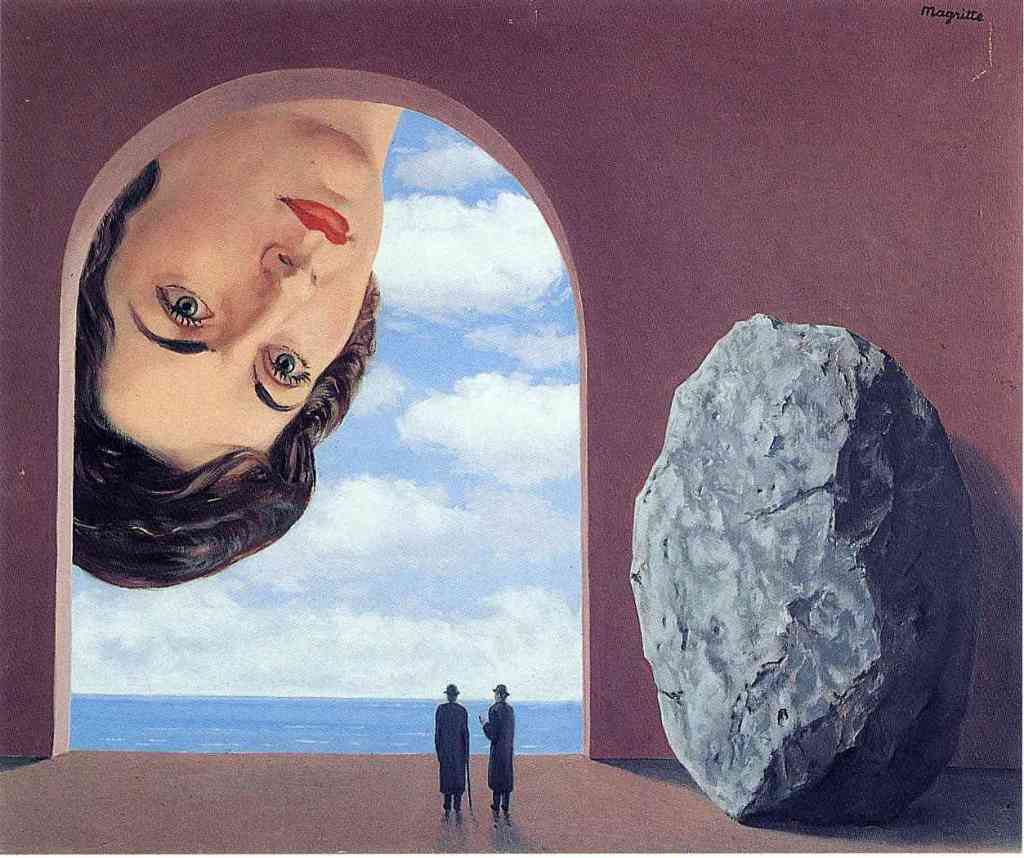
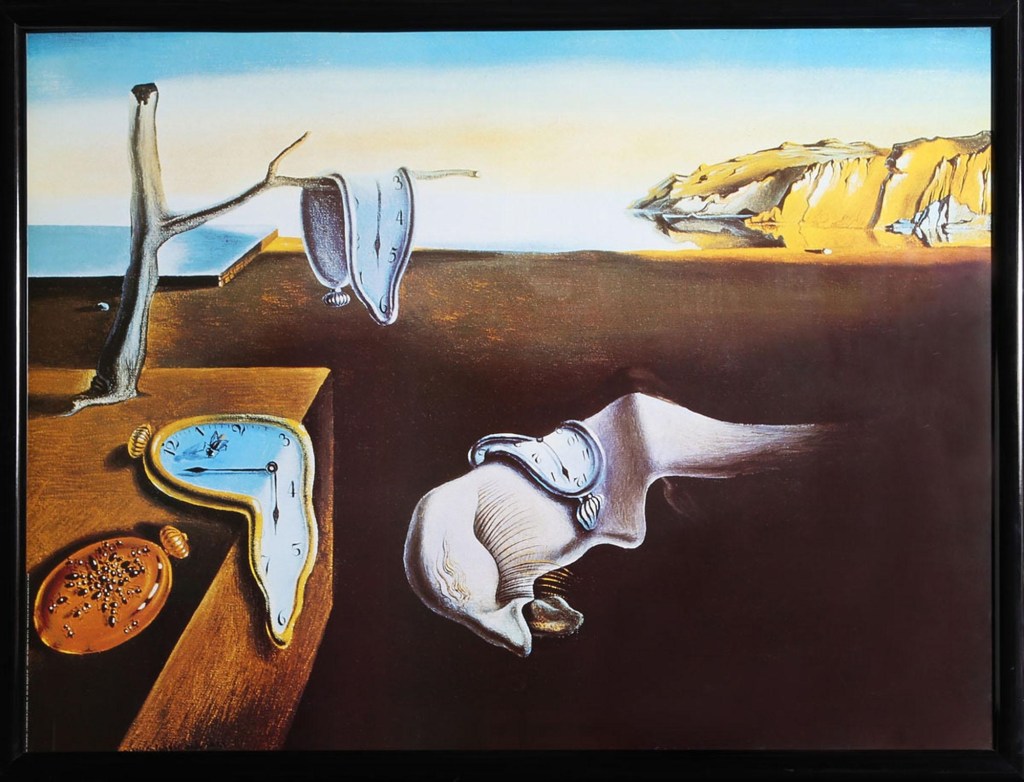
The Big Family, 1963, Magritte The Persistence of Memory, 1931, Dali
References: Center Pompidou website, Tate Modern website

