David Hockney (1937-2026) is no longer with us but he has left a pretty big legacy. Most of his work is inviting but like a sunny day in Scotland, there is always the sense that the weather could turn.
He had moved to Normandy in 2019 and therefore was ideally placed to enjoy the lockdown year getting re-acquainted with nature and creating hundreds of i-pad paintings. For him this was a chance to work uninterrupted, and he made the most of it.
“If you look at the world, it’s very beautiful. But you’ve got to have a clear head and there’s lots of things that stop you looking.”
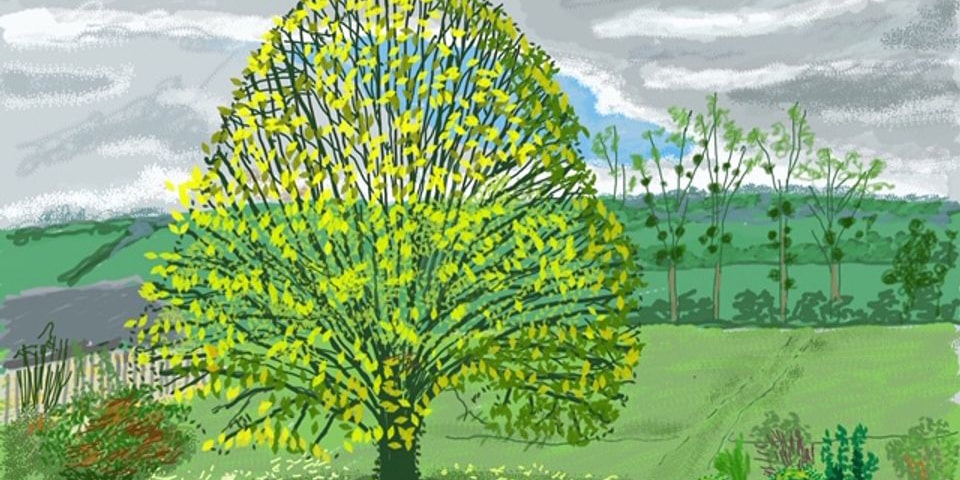
Spring in Normandy 2020
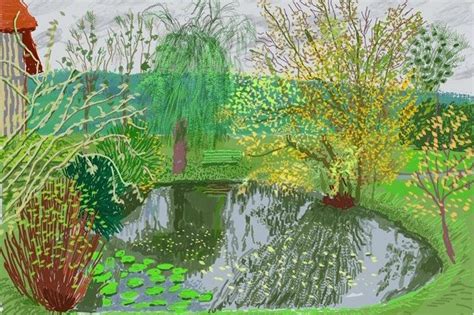
The 116 works chosen for exhibition at the royal Academy were created by the artist from March to June 2020 at his home in Normandy.
They chart the unfolding and progression of spring in the garden of the farmhouse where he was living with his dog Ruby and two of his long-standing assistants. “They can cancel everything but they can’t cancel Spring” said Hockney.
As the 83-year-old artist sent them to friends during lockdown he said that with “the virus going mad . . . many people said my drawings were a great respite from what was going on”.
These images have the freshness of Hockney’s more famous early works from America in the 1960s when he was relishing the light and warmth of California. Here is the famous A Bigger splash from 1967.
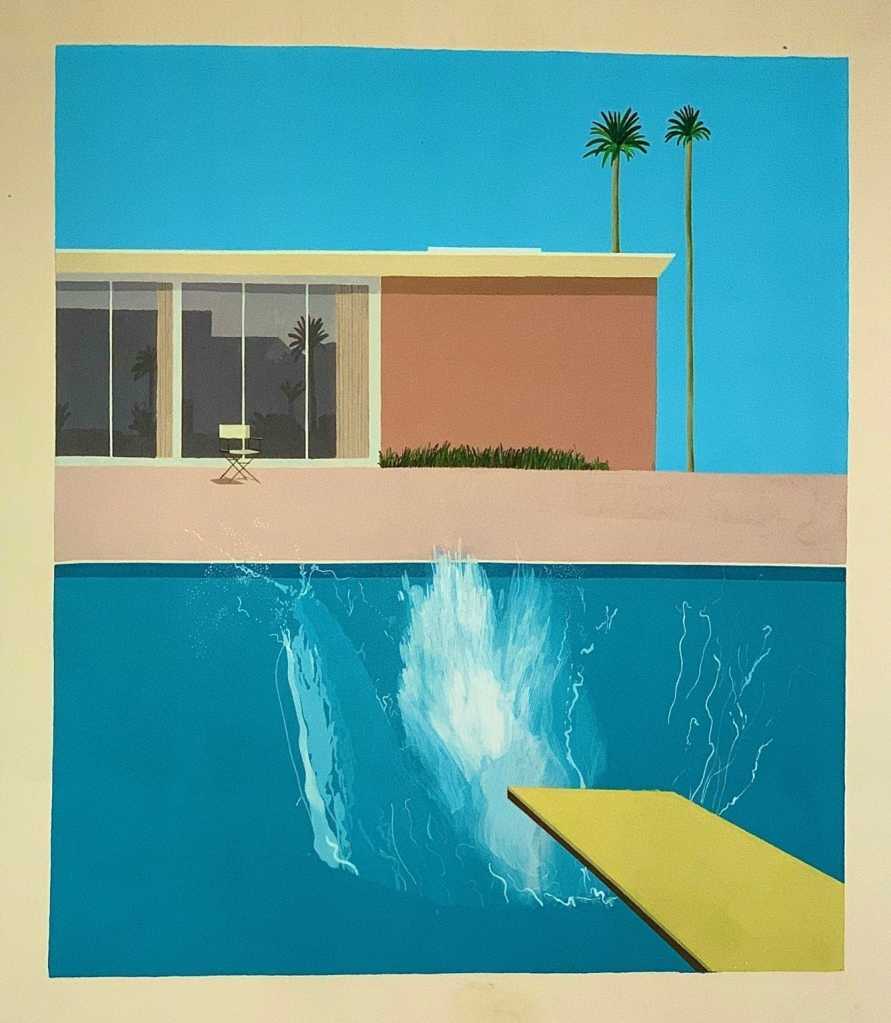
At the start of his career he’s a young man conveying his love of life and energy and the ecstatic explosion of water conveys an ability to seize hold of transcendent joy. Hockney’s famous directness and irascibility never deserted him and enabled him to use every situation to fire up his creative guns.
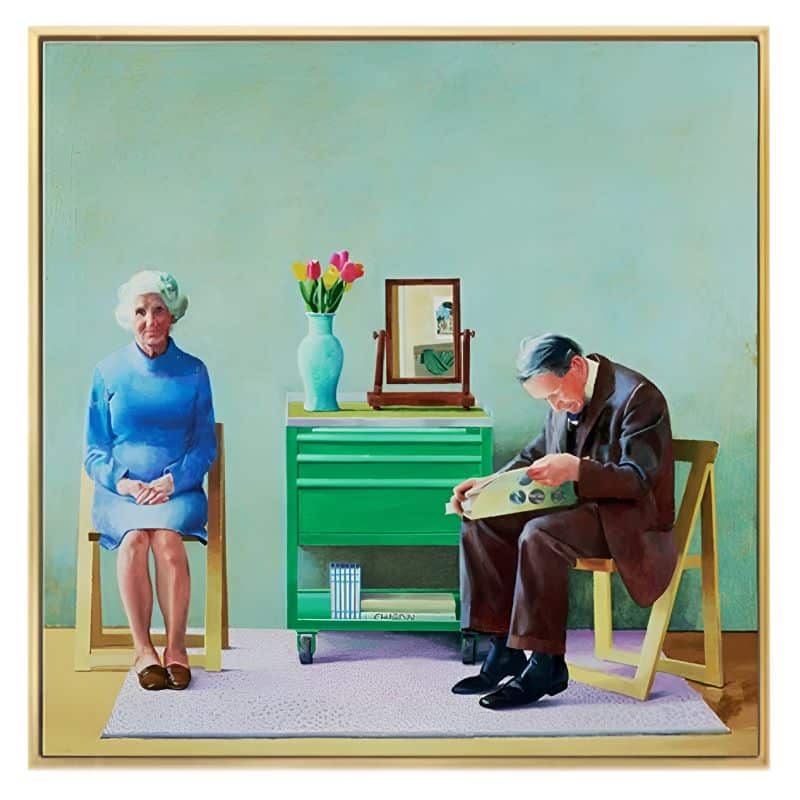
My Parents, from 1977, shows Kenneth and Laura Hockney in Bradford. The direct gaze of his mother makes a loving connection to the viewer but the upright posture reveals an acute, alert mind. His father delves into a newspaper with his heels uncomfortably off the floor. But the blue wall behind them conjures up a depth of space which is the opposite of claustrophobic. Again Hockney has conjured up a veil of quiet joy, a depth of understanding between the two figures and himself.
The postcard of The Baptism of Christ by Piero della Francesca in the mirror provides a prod of conscience into the sublime blue/green of the background. Another use for water to counteract his California frolics?
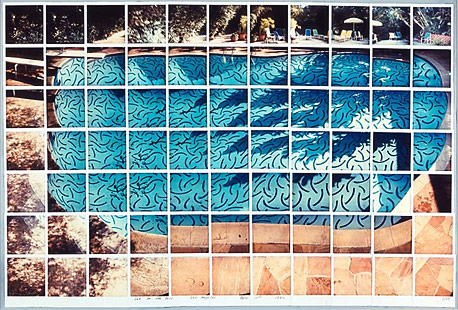
Sun on the pool Los Angeles, 1982. Polaroid composite montage.
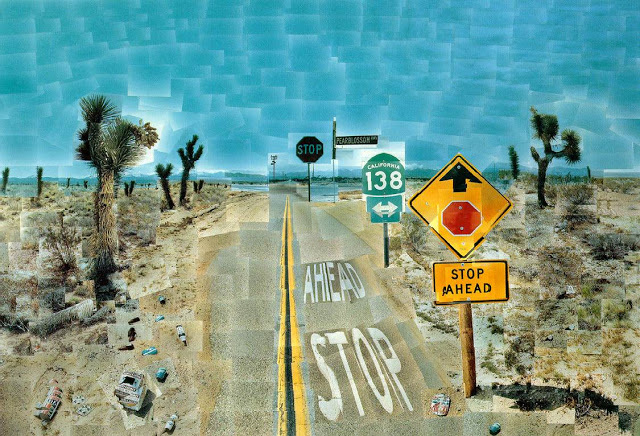
Pearblossom Highway, 11-18 April 1986, No2. Montage of 1000s of colour photos.
These two montages show Hockney’s preoccupation with photography in the 1980s. Along with his belief that camera obscuras and other optical devices had been in use in Italy since the 1500s to help painters understand perspective and relative sizes, Hockney was fascinated by the illusory qualities of the glass lens as opposed to the human eye. But for him photography was a tool for pushing analogue boundaries – which ironically made these works closer to the actual sensory and brain experience of human beings taking in outside reality. We tend to look around a scene, taking in lots of separate details which our brain then connects up using our imagination and past experience along the way. And our memory is crucial to this split second stitching together.
So in the Polariod montage we see the same viewpoint from several slight changes of position to simulate our eyes coming into focus and recognition of the pool – but in a supercharged way because normally we could only focus on one part at a time. In Pearlblossom Highway Hockney has use a colour film camera to take shots from every conceivable angle, both close-up and longer shot, over a period of 8 days. This gives us another supercharged (and massive 2x3metres) image of things we could never see in one go driving along. Or even walking. You would have to keep stopping and crouching down or getting up a ladder (which he did) to have any chance of seeing this much. And really, you should study this image for a couple of hours to do it any kind of justice. I think I managed 10 minutes when I saw it at the Hayward back in the day. It’s a tour de force and shows how far beyond most people’s tolerance for looking Hockey had travelled. And that was then.
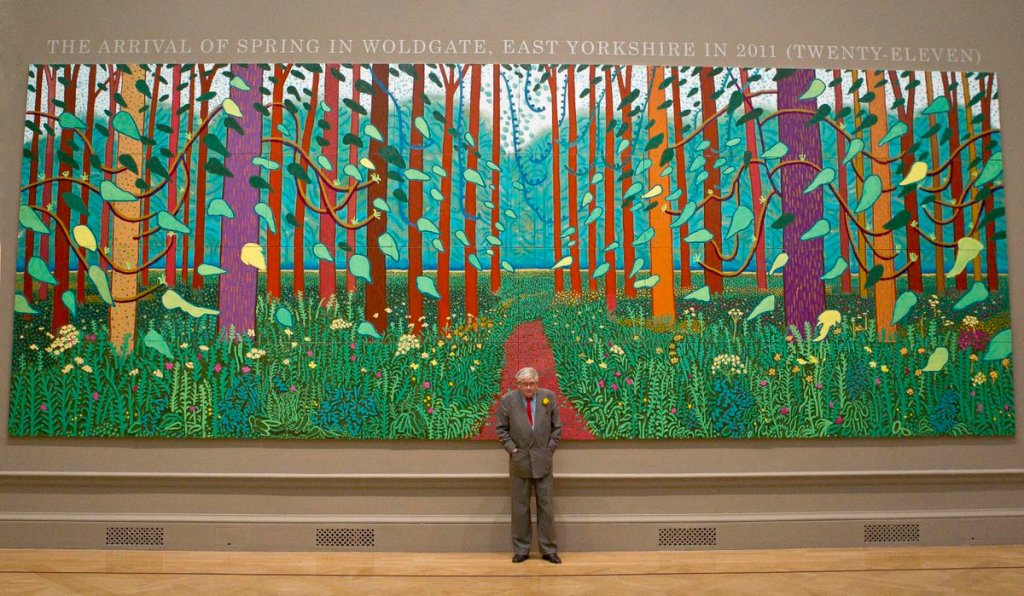
The Arrival of Spring in Woldgate, East Yorkshire, 2011
Hockney was famously a master of colour and this painting from 2011 is a great example. What initially appears a bit garish and far-fetched, even cartoon-like, becomes another way of seeing with more understanding the colours and shapes of nature. Leaves do present themselves to us as familiar shapes and colours have their own identities which combine in nature to become the scenes we expect to see. Hockney wants us to see the particular within the general. And then to perceive the joy of vivid colour more fully. The love of life is still there in this sophisticated large scale post-modern pop art painting.
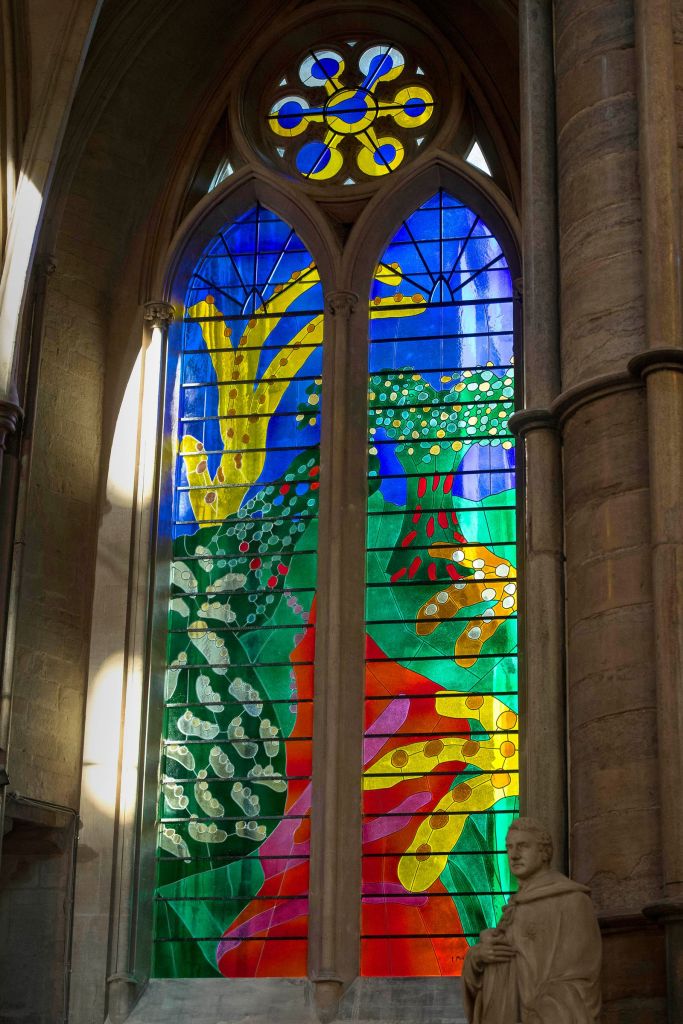
Queen Elizabeth II window, 2018, Westminster Abbey
There are elements of pop art too in this late work, Hockney’s only foray into stained glass. Designed on an i-Pad to simulate backlighting effects, but also in consultation with Barley Glass Studio and using mouth-blown glass from Lamberts in Germany, Hockney has managed to again transcend the simplicity of individual elements and this time make room for real light to complete the picture. As an artist in glass myself I was skeptical about Hockney’s ability to translate a simple design into the medium of glass. I have yet to see the window in situ but from photos of the installed panels with light pouring through them, I am more convinced that Hockney has chosen the right combination of elements to create a joyful veil of light and colour – texture and colour combinations ( he worked with Lamberts to develop the characteristic Hockney pink and chose all the other colours from mouth-blown stained glass). However I’m still not totally convinced by the shapes in the design of the window based on hawthorn blossom and the Yorkshire wolds. I feel he was more assured with pushing painting boundaries, for obvious reasons, but at least he has brought some vibrant colour into Westminster Abbey!
Back in 1979 Hockney wrote in the Observer: “Art is not just a luxury or a self-contained activity. It has a profound influence on other aspects of our lives, both directly – as in the case of architecture and design – and indirectly, in the way we respond to the world around us…” His life’s work has been a living testament to these words. He has shown us that being constantly inquisitive and questioning about what our perception of the world can look like can extend our understanding of what it means to be human. Now that’s a great legacy.

