There is currently an exhibition at Gracefield Art Gallery in Dumfries, Scotland, of works by Edinburgh-based Palestinian artist Leena Nammari. She is currently undertaking a practice-based PhD and this selection of her work explores universal themes of yearning, longing and myth-making that resonates across borders and cultures. But Leena is quick to point out that “haneen is NOT nostalgia, it is a much bigger force than that.”
“As Palestinians, we live with haneen every day. We wake up to it, we dine with it, we go to bed thinking of it. We listen to music laced with it, we recite poetry bursting with it. Every memory is soaked with it. Every thought has a sense of haneen. The music we listen to, to the art we look at and make. We have haneen for all things past and for what is to come.”
“Displaced persons, forcefully or voluntarily displaced, collect objects that appear meaningless: saucers, plates, pots, pans, forks, knives, a jacket, a string of beads, random photographs and sanctify what was lost, found, collected, discoverd and missed. They collect the everyday objects, the discarded and the unimportant. But most importantly, they collect and retell their stories. This is haneen…”

“We build up a sense of haneen to places we have never visited…from stories we have been told, stories we relay, and stories we make up.”

Nammari says “Books will be the blueprint of our continued education and enlightenment. Scholarship must continue to enlighten our young and old.” This is true for any culture seeking to stay alive and preserve its identity. It is true for Palestine, Ukraine, Afganistan, Syria and many others which have been devastated by brutal politics. But for Palestine the heaviness of history is perhaps more acute than most.


These photo-etchings with added gold watercolour have a sense of longing for a past which goes beyond nostalgia. The very stones are crying out for true calm and an end to violence.

“I photographed this house in Ramallah for two decades, watching it be ravaged by time and hoping it would live for another two decades. In 2017 I photographed it with scaffolding in front and now I know it will live.”
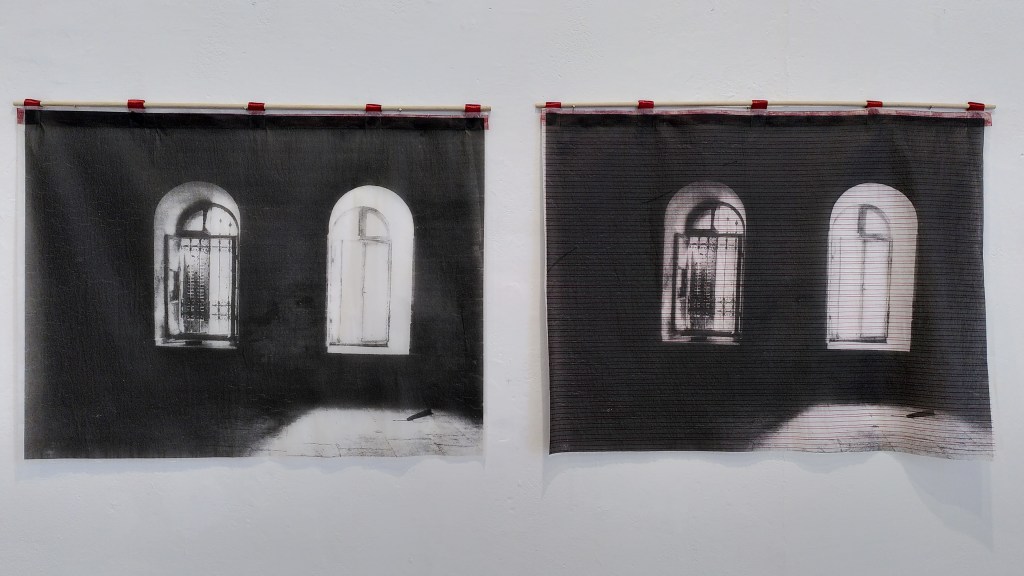
“A small house I stumbled upon on old town Ramallah…my friend Samar and I found the dpoor open and we snuck in. I took a few photos of the interior, and I hope this building survives the ravages of time…It had a haunting beauty, light seeping through shutters, air filled with dust.”
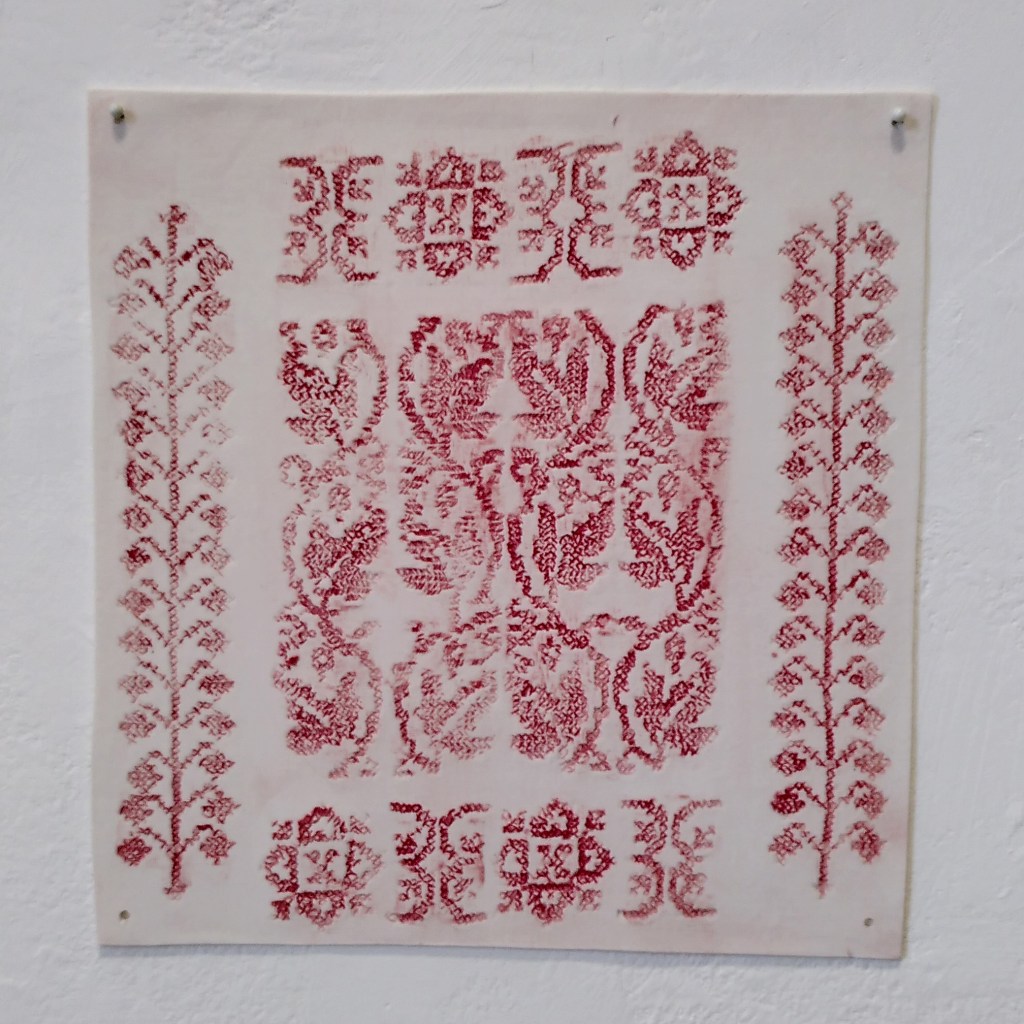
Printed from hand embroideries, reflecting motifs from peasants dresses in the Ramallah region, these fragile thin tiles of porcelain stand as evidence that a culture still survives despite the destruction of so many Palestinian villages since 1948. ” They all mean someting; they reflect where we are from, what region, village and what flora and fauna suround you. A small piece of cloth will tell you what village you are from and all that remains of the village, sometimes, is the embroidery.”

This small sculpture with playful childish curses derived from the old testament carved into the wood sums up for me the essence of haneen – the fragility of everyday connections between people who rely on each other to remain connected to a place which can easily be destroyed…
A number of local artists from South West Scotland Printmakers were invited to contribute a personal response to the idea of haneen and these are on display in the upper gallery.


Haneen in our own times and place, felt by the many Ukrainian, Syrian, Afgani and other refugee folk who are living their lives from the prison-like safety of hotel rooms across the UK. There are many hopes and dreams contained within these gilded cages.

This final work was started in 2020 before we moved up to Dumfries, inspired during lockdown by an organised socially distanced protest in Israel that I saw on Twitter. It was finally glaze fired in the past month and it fractured in the kiln. This unexpected outcome for me represents the current agonising conflict in Israel/Palestine which we all feel so keenly. The longing for a peaceful settlement in that region has a long history going back to biblical times and perhaps deep down we know there can be no human solution. For me the ultimate haneen is the longing to be in a place beyond this physical world, where we will finally know the peace of God.
The exhibition at Gracefield Art Centre runs until 3 February 2024.
 AndyLJBrooke
I wondered about resonances with the word “Hiraeth” (from the language usually called Welsh by those like me who cannot speak it).
“Hiraeth is a protest. If it must be called homesickness, it’s a sickness come on — in Welsh ailments come onto you, as if hopping aboard ship — because home isn’t the place it should have been. It’s an unattainable longing for a place, a person, a figure, even a national history that may never have actually existed. To feel hiraeth is to feel a deep incompleteness and recognize it as familiar.”
LikeLiked by 1 person
That sounds very much like Haneen. I’m sure all cultures have their own version of it.
LikeLike