The Cambridge English Dictionary defines a flag as: a piece of cloth, usually rectangular and attached to a pole at one edge, that has a pattern that shows it represents a country or a group, or has a particular meaning:
A pretty bland one-dimensional definition until you get to the last two words – particular meaning – but this is the pandora’s box of semiotic confusion.
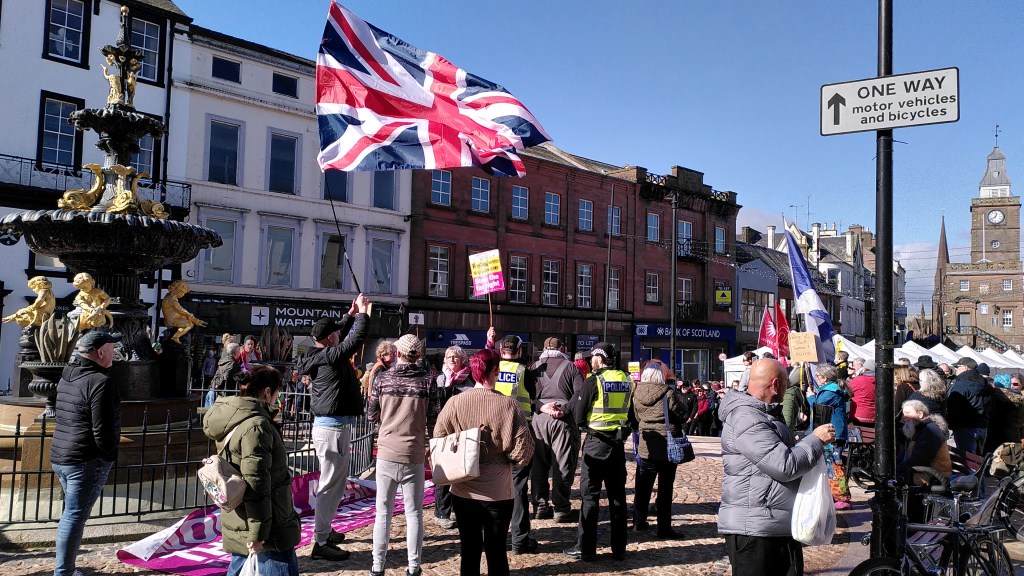
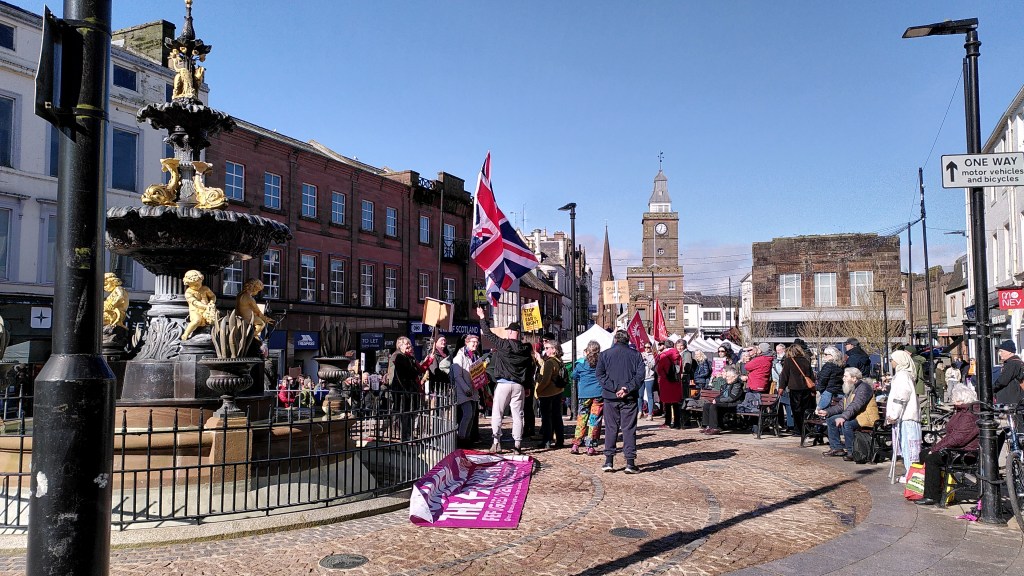
The photo captures a rally in support of young male asylum seekers here in Dumfries – from slightly to the side of the assembled crowd. A man is standing with a union jack flag in open defiance of the intentions of all the other protesters as if his actions can in some way oppose what they are standing for. But as I observed him and listened to the calm reason of the words of the speakers the union jack took on a more neutral symbolism. Watched by the two police officers who allowed it to remain as long as the standard-bearer remained quiet, it turned into a mere flag again. From being the index of hatred and zenophobia it has become in recent years, it bacame a benign presence, another facet of the positive community occasion, even a national stamp of approval.
I have to admit that not everyone present saw it this way and there was a lot of verbal backlash against the chap, whose history I know nothing about. Plus I am making this judgement as a sympathetic observer more than a participant in the rally. But it was a powerful impression and it almost restored my faith in flags as neutral signs of national identity.
I believe most people want to take pride in their nationhood and this is why we cringe when the national flag is appropriated for political gain by any group. On this occasion the importance and power of the event supporting the human rights of asylum seekers in a rich civilised country transcended the semiotic limitations of the national flag and expanded its field of reference to cover all the vaguaries of human opinion. If it can happen here it can happen anywhere in the world, and there is hope in that thought.
 AndyLJBrooke
Food for thought – let’s seek to be peacemakers and to respect other opinions. I tried to post a comment but it would not allow me. Many blessings Stephen
LikeLiked by 1 person
I agree very much with that approach.
LikeLike