My latest stained glass panel has a theme of sand and concrete. Sand is a precious natural resource which takes millions of years to refine into what we know as beach sand. But the sand suitable for construction and concrete known as river sand is being used faster than it can be naturally replenished. At the present level of urbanisation (and rebuild from war) this is due to effectively run out by 2050.
The Concrete Window – painted and printed stained glass panel Andy Brooke 2025
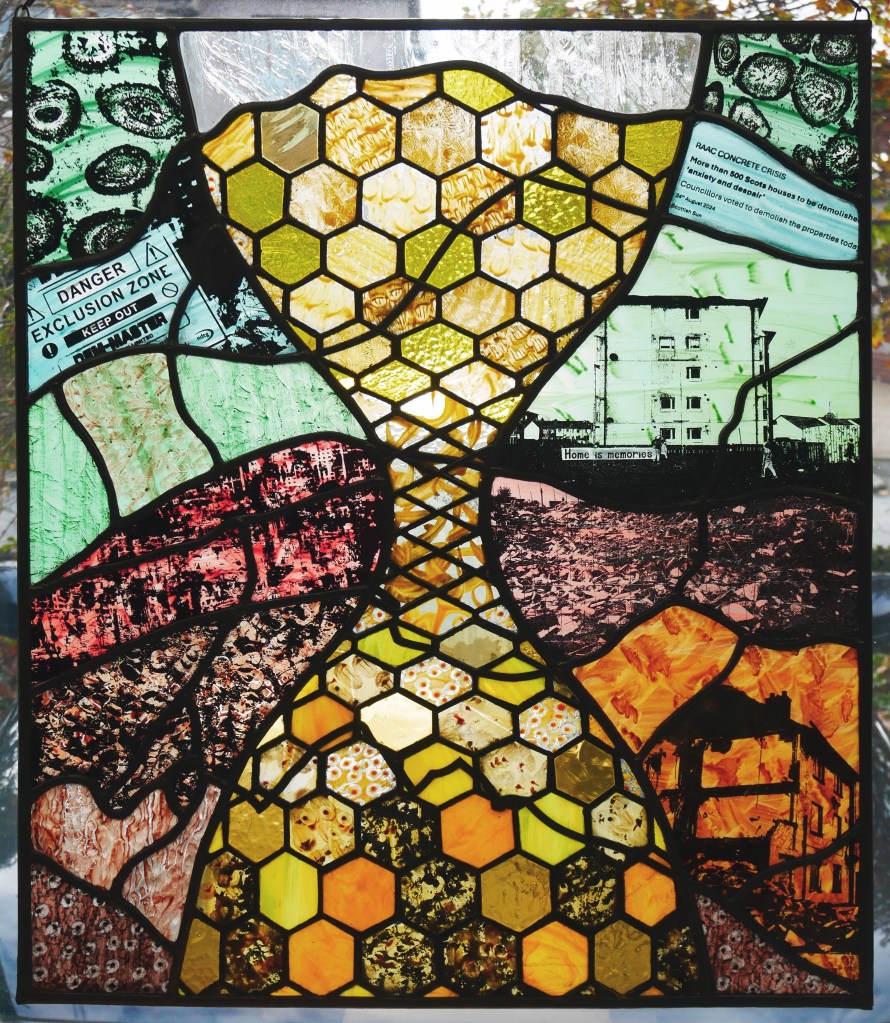
The images in this window refer to the origins of sand and rocks used in the manufacture of concrete, from its plunder of ancient rocks for aggregate to the perpetual cycle of construction/destruction.
The central section of the panel depicts an hourglass with sand particles represented by the hexagonal structure of quartz (silicon dioxide). Sand particles are made mainly of quartz, along with fragments of rocks and shells, seen printed and painted throughout the window panel.
I should add here that glass is made from sand particles…the irony of this is not lost on me as a user of that material! Maybe that makes it the perfect medium for the message.
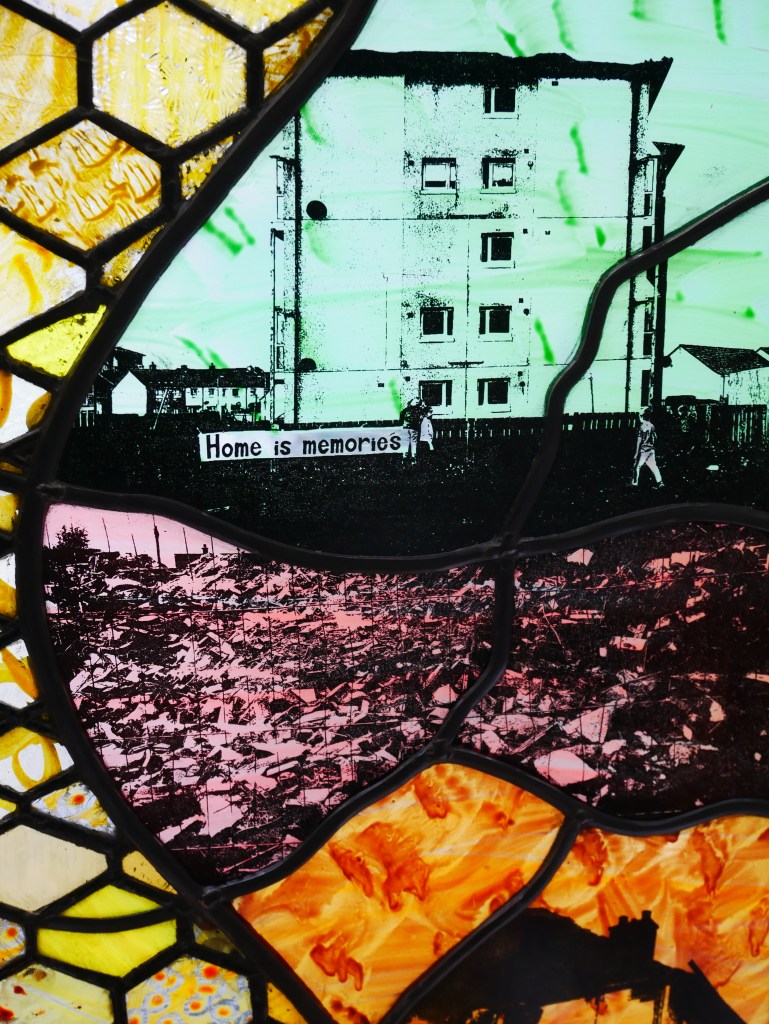
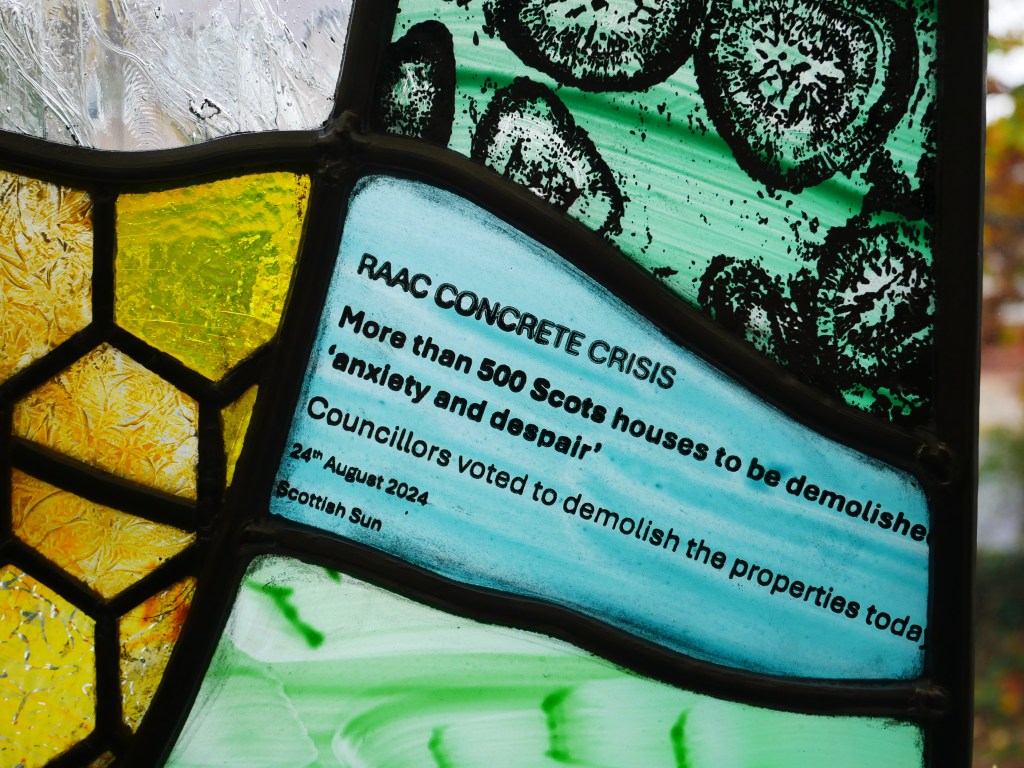
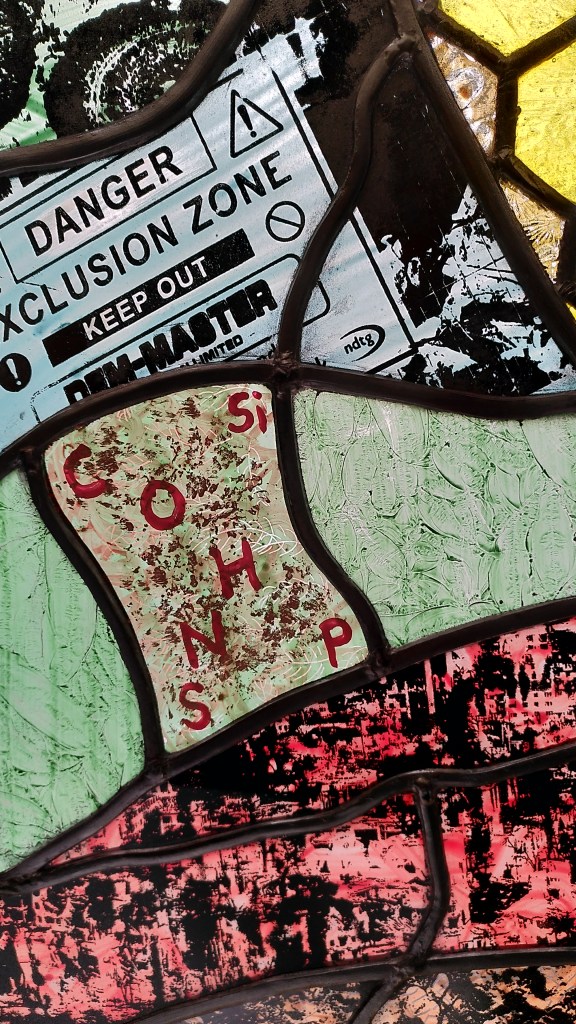
The right section refers to domestic concrete buildings, highlighting the human need for housing. Two contrasting images are from Lochside, Dumfries: an apartment block has a banner “Home is Memories,” and just down the road from this building is a demolished apartment block. There is also reference to the problem of RAAC (reinforced autoclaved aerated concrete) in council housing and the impact this cheap version of concrete is having on many people right now. Their homes are literally crumbling away.
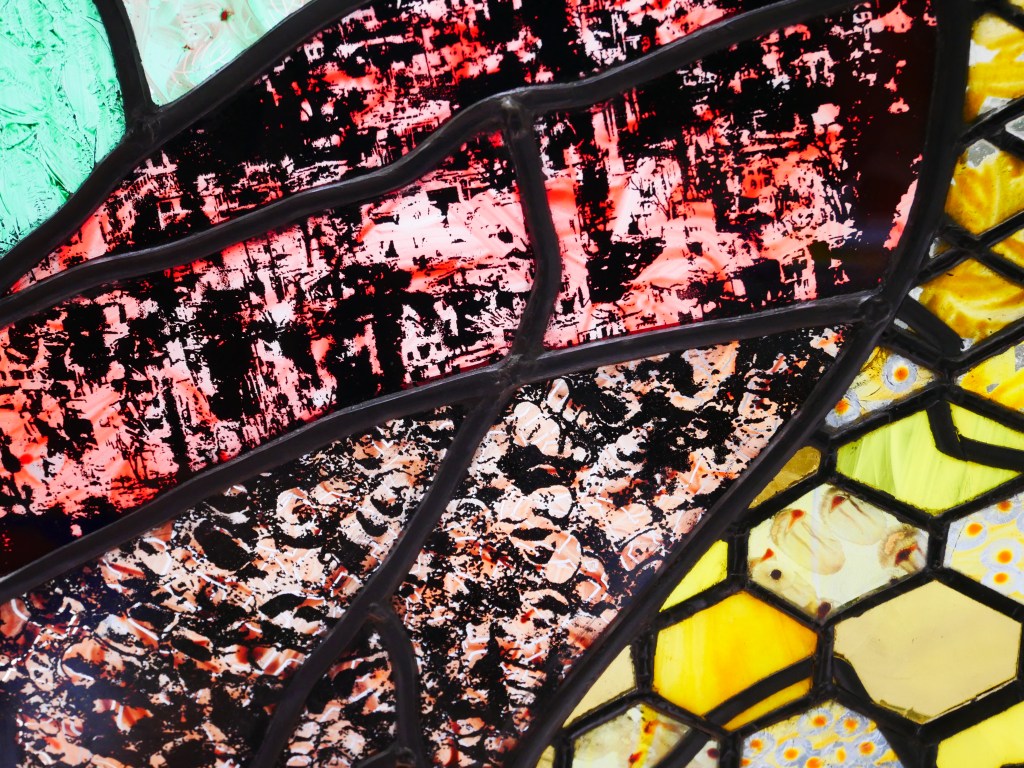
The left section of the panel shows the destruction of civic buildings and their disruption of community life, that of Bakhmut in Ukraine*. The scale of waste of this war alone is beyond comprehension and of course it is not the only site of destruction by war in the world. Beneath this image is one of turritella shell fossils** found in limestone used for concrete aggregate…
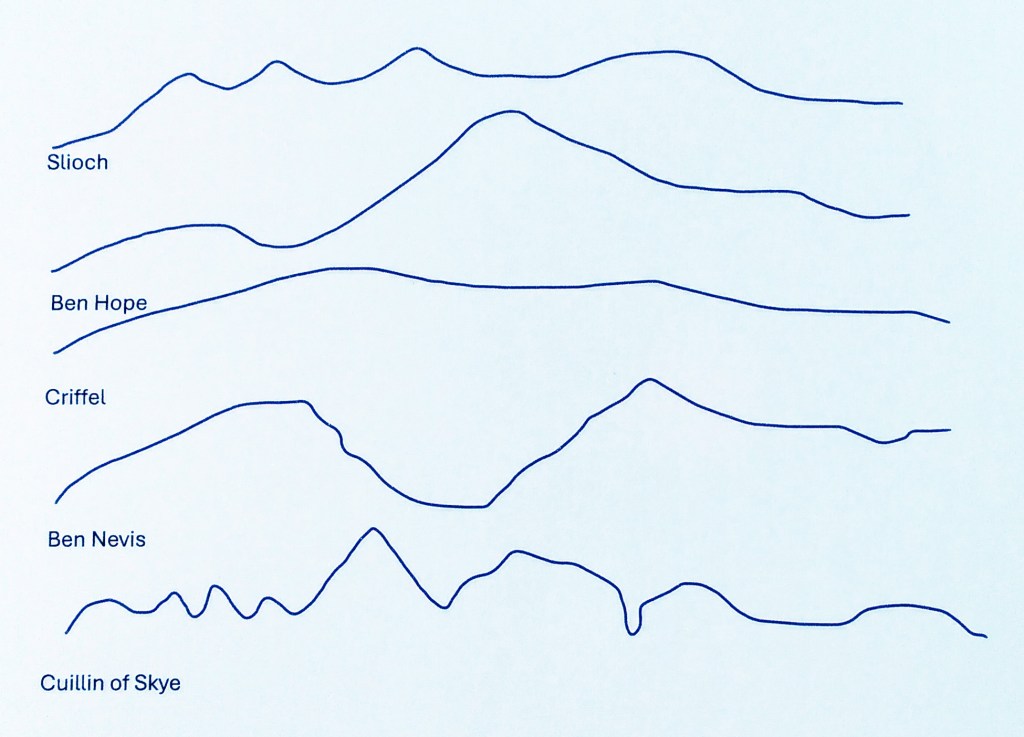
Scotland, with its heavy rock aggregate industry has altered parts of the landscape over time. Look for the horizontal leadlines following the current profiles of well-known Scottish mountain ranges:
I call the glass panel a window because of the symbolism of that word. The work is an attempt to be a transparent view of the world, but not in the usual way. It offers a personal perspective or view of how things ARE in the world. It is a metaphor for the reality beyond our normally carefully cleaned and polished windows. It could be a portal into another way of seeing the taken-for-granted world.
It is not a beautiful window in the expected sense; there is ugliness portrayed in some imagery as well as some of the colours and patterns created. Yet I hope the window retains a sense of cohesion and grace under pressure as the world valiantly strives to counter the ravages of humankind (sic).
There is some colour symbolism – notably the green for hope in human communities (eg the amazing Lochside in NW Dumfries, referenced by the Home is Memories banner). Yellow and gold symbolise the beauty and grace of the flow of sand. The colour red is used to show the savagery of war in Ukraine and across the world and the waste of demolition in local communities everywhere. When you consider that 50% of a building’s lifelong carbon footprint goes into its manufacture/construction, then it becomes a crime to demolish and rebuild unless all other options have been considered.
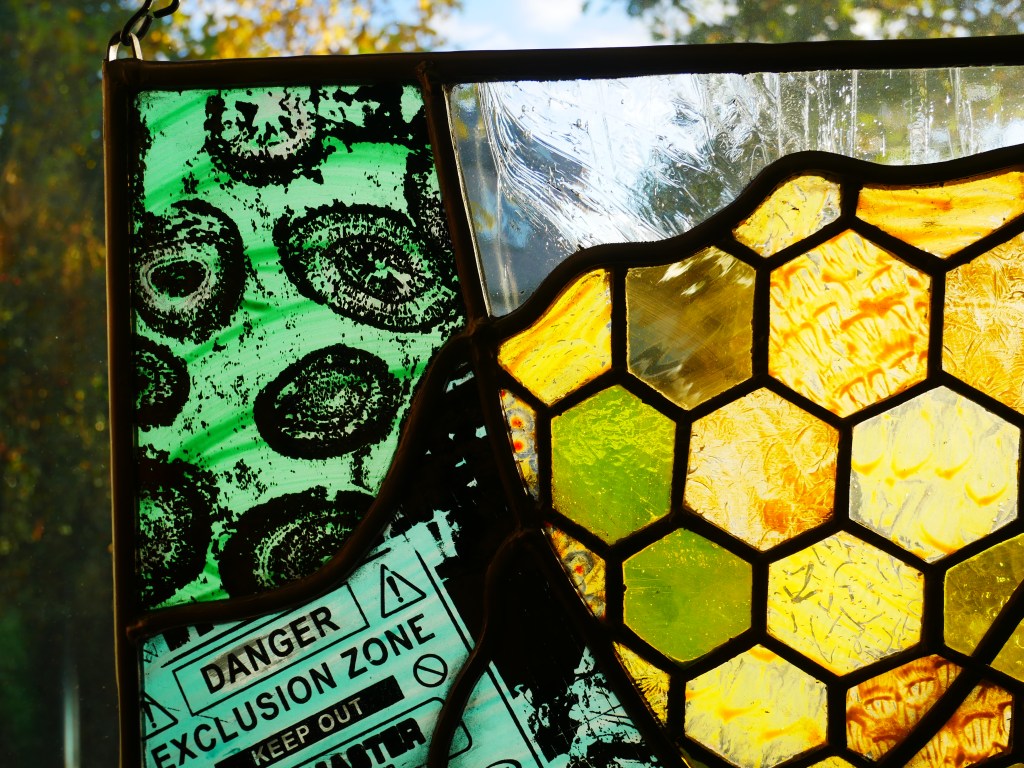
There are a few geological inclusions in the overall design: the top two corners show ancient orbicular granodiorite of great beauty from Mt Magnet, Western Australia. Elsewhere can be found various shells and ancient biological/botanic marine debris/fossils which go to make up limestones. Both kinds of rock are key componets of aggregate used with sand in concrete production. There is also a subtle reference to ancient ferns that can be found in sandstones…
Concrete destroys natural landscapes and creates manufactured, mechanical, manipulated and mercenary landscapes. Instead of contributing to dynamic, living geology, it fabricates permanent earth structures which are irreversible and sterile. Of course the earth has put up with the upheavals of man and his thrusting progress for milennia but we are in a rapidly diminishing cycle of no returns as the lust for technological materiality overtakes our desire for spiritual understanding.
Financial materiality (the judgement of what is considered relevant for a desired financial outcome) is also seeping into the subconscious of our thinking as the concept of truth and good sense is subverted by financial political outcomes and the personal agendas of absurdly rich people. The currency of common sense and hard-won logic for human survival becomes just another strand of information to go through the mangle of self-destructive and pointless greed.
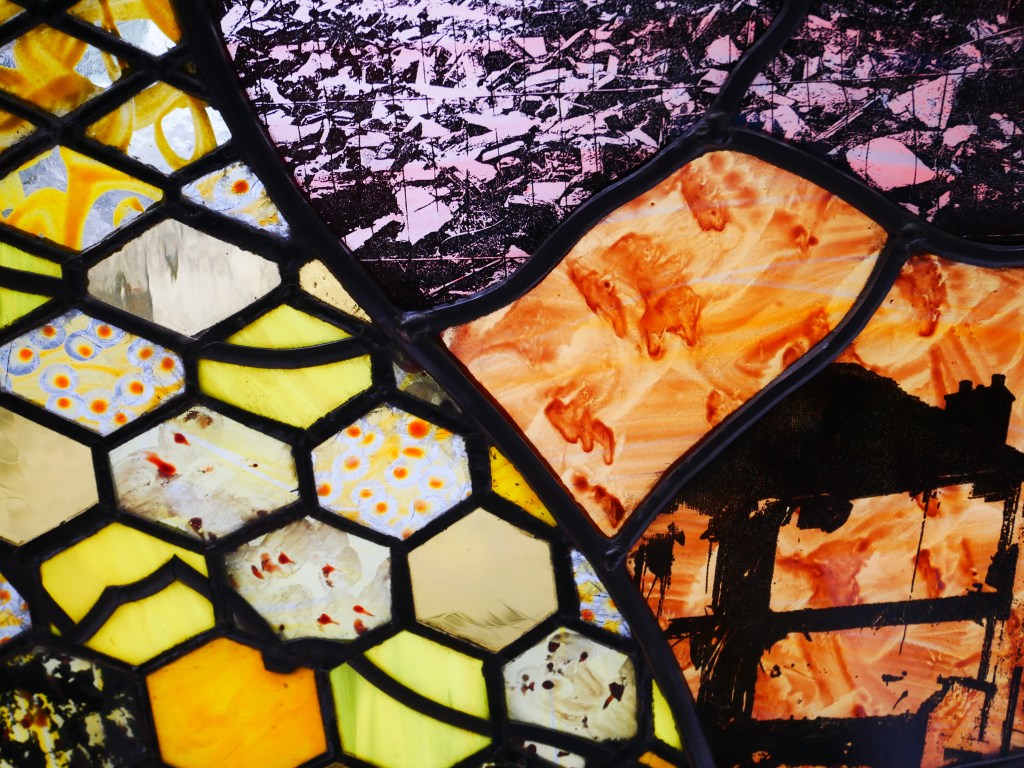
The metaphor of the hour-glass declares that one day useable sand will run out and ultimately the time will be up for production of more useable sand. This is a potentially irreversible continuum leading to environmental stagnation and the necessity for a different way of approaching the meaning of life.
But there is hope that if we can use sand more efficiently, re-use concrete, extend the life of buildings, use lighter weight construction designs (eg timber frames) and develop wood/cardboard/earth as a building technology, then the projected output for sand use by 2060 could be halved.***
We could start by not building that probably unnecessary extension to our kitchen…
*Original image of Bakhmut ruins by Roman Playshko, Shutterstock
**Turritella shell fossils from Science Photo Library
***Xiaoyang Zhong of Leiden University quoted in “We are running out of sand and global demand could soar 45% by 2060” – article in New Scientist 24 March 2022
 AndyLJBrooke
Again a complex of symbolism brought together so eloquently in creative form, and your discussion of it enriches thoughtful work still further!
LikeLiked by 1 person
Thanks James, the work has provoked much creative and heartfelt discussion.
LikeLike